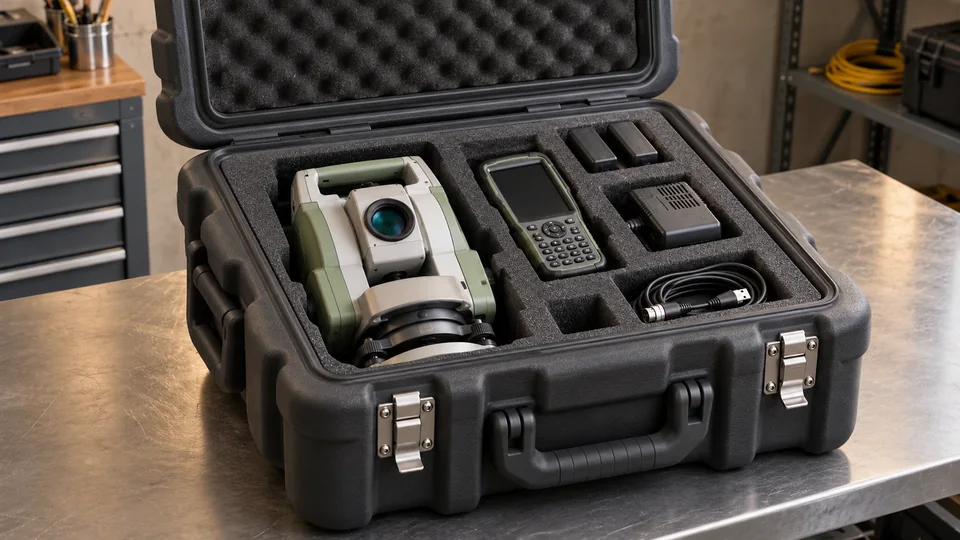
The case has arrived, the shell looks sound and the main device is inside. Can the team start work? A missing adapter, an unsupported delicate component or damp equipment packed after fieldwork can still interrupt the job. Equipment manufacturers, integrators, service teams and rental operators need to consider the complete journey: packing, handling, transport, deployment and return.
Start with the complete working kit
A device rarely travels alone. Batteries, chargers, antennas, cables, calibration accessories, tools and spares belong in the selection brief. Define the current working configuration before choosing an empty case. Distinguish transport packaging from an organised kit and from equipment intended to operate inside an enclosure. Operation inside introduces ventilation, power and cable-routing requirements; a transport case is not automatically a workstation.
- Record the device version, dimensions, weight and centre of gravity.
- List every task-critical accessory and protruding part.
- Mark load-bearing areas and fragile features requiring clearance.
- Describe whether equipment is removed for use or must operate inside.
Review cushioning as well as the shell
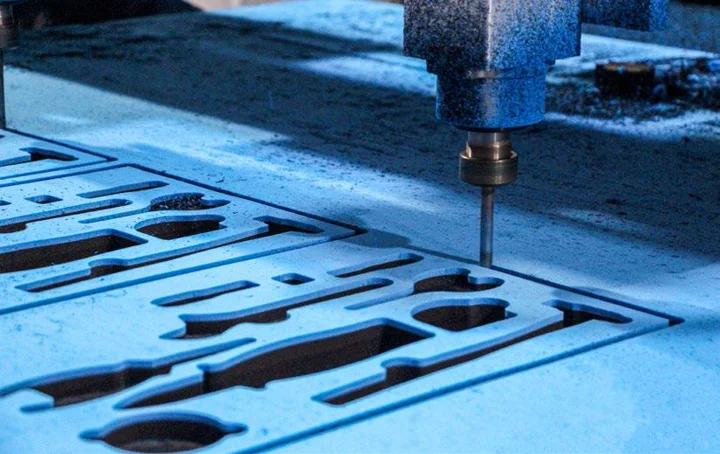
The shell encloses the kit; internal supports and cushioning determine how it is held and how loads reach it. A neatly cut foam outline does not establish adequate protection. A lens may inadvertently support weight, the lid may press on a control, or accessories may collide. Material selection, weight distribution and space for cushioning need consideration together. Review support points, lid clearance, accessory separation and complete loaded-package test records to inform the configuration choice.
- Check support points, lid clearance and separation between components.
- Review cushioning materials and available protective space.
- Request evidence for the specified loaded package and an appropriate test plan.
Make missing accessories visible
A working instrument can become unusable without its cable. An absent charger may cause trouble later in a field assignment. Defined positions, labels and a packing checklist help people notice gaps before departure and at handover. The layout must reflect the working configuration, including consumables, replacement cables and updated accessories, rather than a single ideal equipment photograph.
- Give essential accessories identifiable locations.
- Check the kit against the current packing list before dispatch and handover.
- Review the layout when consumables or accessories change.
Design around the order of work
The first item needed on site should be accessible without unnecessary unpacking. Observe a user opening the case, identifying components, removing them, setting up and repacking. Use the gloves, workspace and handling constraints relevant to the task. Finger clearance, heavy-component positions and trays can change usability. A rendering cannot demonstrate faster deployment; access problems, repacking errors and task time need observation.
- Rehearse opening, removal, setup and repacking.
- Check finger access and the position of heavy items.
- Record difficulties and revise the layout before approving it.
Separate weather protection from internal moisture
Wet equipment and humid packing air can introduce moisture inside a case. An ingress-protection claim concerns defined external exposure conditions; it does not mean the interior can never contain moisture. Drying, inspection and suitable moisture-control provisions remain application questions. Humidity indicators and desiccant-related features appear in professional case configurations, but availability must be checked for the selected model. Pressure equalisation is not active dehumidification.
- Inspect and dry equipment before closing the case.
- Review moisture-control needs and maintenance procedures.
- Verify the selected model's seals, valves and supporting environmental evidence.
Compare complete logistics arrangements
Combining equipment can simplify inventory while increasing loaded weight, volume and handling difficulty. Dimensional weight may affect freight charges depending on the carrier service and market. [1] Vehicle space, stairs, rough ground and lifting equipment also matter. A single large case is not necessarily better than smaller cases. Manual handling depends on the load and task, rather than a universal safe weight. [2]
- Compare external dimensions, loaded weights and freight rules.
- Check the handling route, vehicle space and return journey.
- Keep necessary cushioning space when evaluating package size.
Review changes and repeated use
A new battery, lens or accessory may change fit, balance and support even when the lid still closes. Link the equipment version, accessory list, insert drawing and tested configuration. ISTA identifies product, packaging and transport changes as reasons to consider retesting; assess the change rather than assuming every modification needs a new certification programme. [3] Repeated use also requires return inspection and clarity about replacement components.
- Review configuration changes against earlier test evidence.
- Inspect seals, wheels, latches and inserts after return.
- Confirm which parts are replaceable and whether spares and instructions are available.
Compare total cost and prepare the enquiry
Compare purchase price alongside freight, handling, repair and replacement inserts using actual customer records. Do not assume every incident creates a large loss or that another case would have prevented it. Broad claims such as military quality and reports for different models or loads cannot replace configuration-specific evidence. For a ZJFunder enquiry, describe the equipment and its intended job.
- Equipment: current version, dimensions, loaded weight, centre of gravity and fragile areas.
- Application: accessories, transport route, handling constraints, environment and deployment order.
- Scope: case model, interior, included accessories and replacement components.
- Evidence: test methods, conditions and configuration covered.
- Delivery and maintenance: quantity, custom work, lead-time basis and spare-part arrangements.
Questions Before Selecting a Case
What should I specify before selecting a rotomolded equipment case?
Provide the current device version, dimensions, loaded weight, centre of gravity, fragile areas, accessory list, transport route, environment and deployment sequence.
Does an intact outer case prove the equipment was protected?
No. Internal supports, cushioning, clearances and load paths also matter. Review the complete loaded package against an appropriate test plan.
Does a pressure valve remove moisture inside a case?
A pressure-equalisation valve is not an active dehumidifier. Packing equipment dry and managing internal moisture are separate considerations from external ingress protection.
Should equipment packaging be reviewed after a product change?
Yes. Changes to weight, accessories, dimensions or packaging can affect fit and the relevance of earlier test evidence. Assess whether the changed configuration requires further evaluation or testing.
Is one large protective case better than several smaller cases?
It depends on cushioning requirements, loaded weights, external dimensions, freight rules, handling route and the task. Compare complete arrangements rather than empty-case size alone.